
Nonograms
Numbers around the edges, a full-colour picture at the heart of the grid.
Fill in the cells according to the clues for each row and column to reveal a hidden picture. Every grid is drawn by the program, verified to have a unique solution and rated according to the techniques it requires.
- Players
- 1 player
- Length
- 2 to 40 min
- Solo
15 days of full access, no account · No download
How to play
Goal
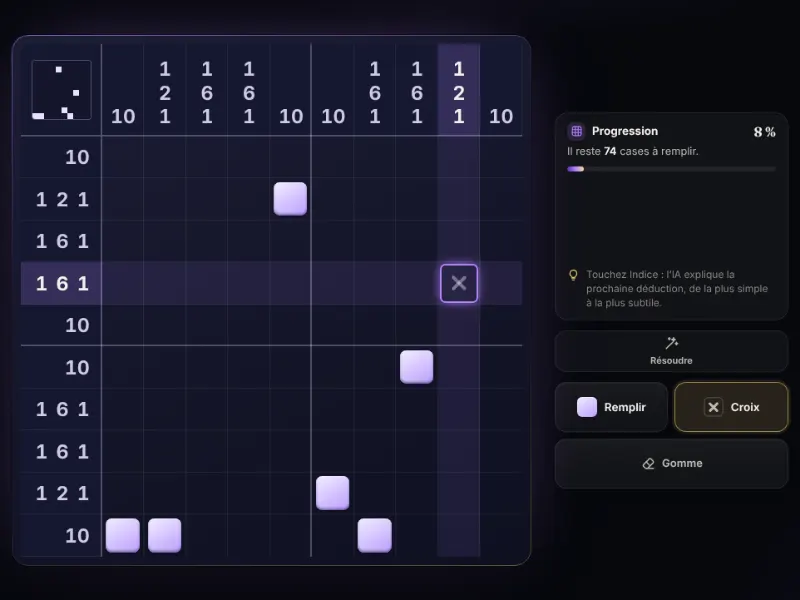
Every row and column carries a sequence of clues: the lengths of the blocks of filled cells it contains, in order (left to right, top to bottom). Between two blocks there is at least one empty cell; the clue 0 stands for an empty line. Fill in the right cells to reveal the hidden picture, which lights up in colour at the end.
Controls
- Tap a cell to fill it; tap it again to clear it.
- Drag to fill several cells in one stroke: the stroke stays on one row or column, and a bubble shows its length.
- Cross mode (or right-click): mark the cells you know are empty. Eraser mode: erase by dragging.
- Keyboard: arrow keys to move, Space or 1 to fill, X or 2 for a cross, 0 or Backspace to erase, Shift + arrow keys to draw. Ctrl + Z undoes.
- Satisfied clues fade; a line that has become impossible turns red.
- Magnifier (small screens): enlarges the grid; scroll it by dragging over the clues or with two fingers.
Techniques
- Overlap: a block longer than the slack of its line necessarily covers its central cells.
- Basic rules: empty or finished lines, exact fill, cells out of reach, edge start.
- Extreme placements: push all the blocks to one side, then to the other, respecting the known cells; whatever coincides is certain.
- Contradiction: suppose a cell is filled; if the deductions lead to an impossible line, it is empty (and vice versa).
Levels
- Easy (5 × 5) and Medium (10 × 10): basic rules.
- Hard (15 × 15): full single-line reasoning.
- Expert (20 × 20): short contradictions.
- Devilish (20 × 20): chained contradictions.
About the AI
Every picture is drawn by the program (shapes, silhouettes, symmetrical patterns), then rasterized into pixels. A solver that reasons line by line, like you, checks that the grid can be solved without ever guessing: its solution is therefore unique. It rates the grid by the techniques that are indispensable (basic rules, full single-line reasoning, short or chained contradictions); if the picture is ambiguous or not demanding enough, a few cells along its border are retouched until the desired level is reached. The same solver explains each hint and animates the Solve button. Generation runs in a separate thread.
Difficulty levels
- EasyBasic rules: overlaps, edges, finished lines (5 × 5 grid by default).
- MediumBasic rules on a larger grid, where the lines cross more (10 × 10 by default).
- HardRequires full single-line reasoning, through extreme placements (15 × 15 by default).
- ExpertRequires at least one short contradiction (20 × 20 by default).
- DiabolicalRequires chained contradictions: the ultimate challenge (20 × 20 by default).


