
Minesweeper
Work out where the mines are from the numbers.
The great classic, from Beginner to Expert, with an always-safe first square, “no-guess” boards solvable by logic alone and a hint that explains every deduction.
- Players
- 1 player
- Length
- 1 to 15 min
- Solo
15 days of full access, no account · No download
How to play
Object of the game
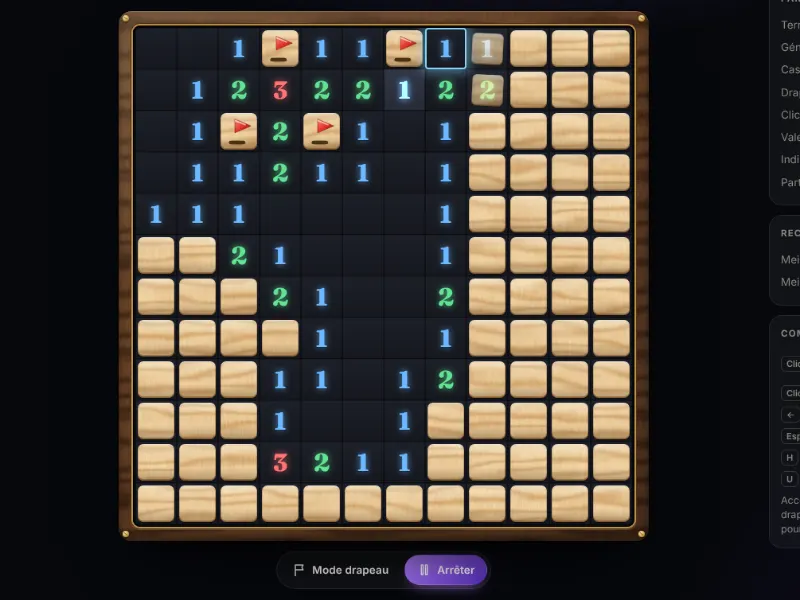
Uncover every square that does not hide a mine. Each number tells you how many mines are among its eight neighbours (sides and diagonals).
How to play
- The first click is always safe and opens an area: neither the chosen square nor its neighbours hide a mine.
- A square with no neighbouring mine opens by itself, along with all its neighbours.
- Right-click (or long press on a touch screen): place a flag, then a question mark, then nothing. The “Flag mode” button also lets you mark with a simple tap.
- Chording: tap a number that is already surrounded by the right number of flags to uncover all its other neighbours at once. Careful: a misplaced flag will then set off a mine.
- The mine counter shows the remaining mines minus the flags placed.
- On a small screen, the Magnifier enlarges the field; drag it with your finger, or pinch to zoom.
- Keyboard: arrow keys to move the cursor, Space to uncover (or chord), F to mark.
No guessing
With the “No guessing” option, the board is generated after your first click and checked by the solver: it can be finished entirely by logic, without ever having to guess. In “Classic” mode, the mines are placed at random and you sometimes have to take a risk.
Levels
- Beginner: 9 × 9, 10 mines.
- Apprentice: 12 × 12, 20 mines.
- Intermediate: 16 × 16, 40 mines.
- Advanced: 24 × 16, 70 mines.
- Expert: 30 × 16, 99 mines.
On a portrait screen, rectangular fields are shown vertically.
About the AI
The solver reasons like an expert player, from the simplest to the most subtle: a number whose mines are all known frees its other neighbours; a number with as many covered squares as expected mines marks them all; two neighbouring numbers are compared (subsets and overlaps, as in the 1-2 pattern). When needed, it exactly enumerates every possible arrangement of mines along the frontier, component by component, and combines them with the total number of remaining mines: this gives it the certainties and the exact probability of each square. The hint presents the simplest deduction, highlighting the numbers that justify it. “AI solve” chains these deductions together and stops rather than guess.
Records (best time) are only validated without undo, without hints and without help from the AI.


