
Backgammon
Dice, racing and risk-taking: the oldest of the great race games.
Take your fifteen checkers around the board and bear them off before your opponent. Full rules, with gammon, backgammon and an optional doubling cube.
- Players
- 1 or 2 players
- Length
- 15 min
- Against the AI
- Two players on one device
15 days of full access, no account · No download
How to play
Goal of the game
Take your fifteen checkers all the way around the board, gather them in your home board, then bear them all off before your opponent.
How it works
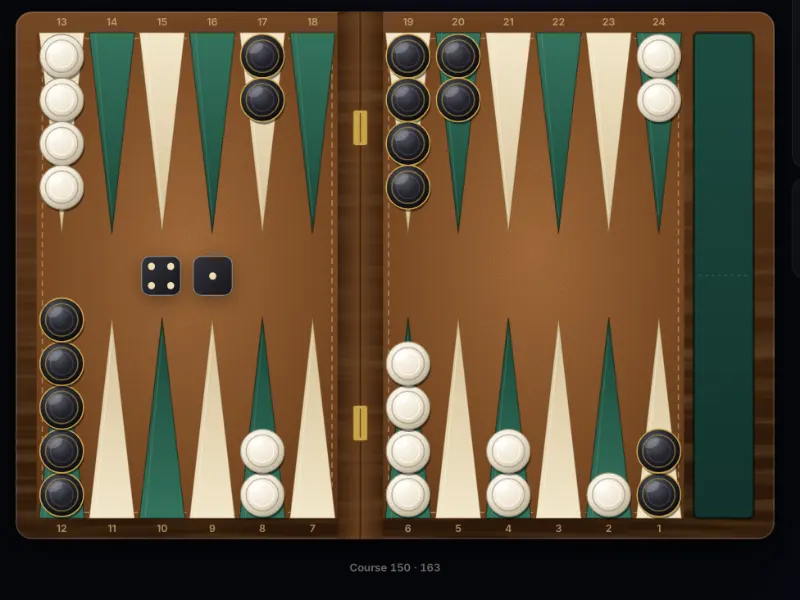
- White moves from point 24 towards point 1; its home board (points 1 to 6) is at the bottom right. Black travels the opposite way.
- At the start, each player rolls one die: the higher roll goes first and plays both values rolled.
- On your turn, roll the two dice and move one or two checkers by those numbers of points. Doubles are played four times.
- You cannot land on a point occupied by two or more opposing checkers. A single checker (a blot) can be hit: it goes to the bar.
- A checker on the bar must re-enter the opponent’s home board before any other move.
- You must play as many dice as possible; if only one die can be played, it must be the higher one, when possible.
- When all your checkers are in your home board, you can bear them off: with the exact die, or with a higher die if no checker is further back.
- Gammon (stake doubled): the loser has borne off no checker. Backgammon (stake tripled): in addition, they have a checker on the bar or in the winner’s home board.
- Doubling cube (optional): before rolling the dice, you may offer to double the stake. Your opponent either accepts and takes the cube, or resigns, losing the current stake.
- Tap a checker then its destination, or drag it. Your moves can be undone until the turn is confirmed. Space or Enter: roll, then confirm.
About the AI
Two-ply expectiminimax search: each candidate move is judged by averaging, over the opponent’s 21 possible rolls, its best reply. The evaluation weighs the race, exposed blots with the exact probability of being hit, points made, primes, anchors, checkers on the bar and risk-taking according to the race; pure races are estimated with a probabilistic formula. The cube is handled from the estimated probability of winning. Lower levels play one ply deep, with inaccuracies.
AI levels
- BeginnerPlays almost at random.
- AmateurAvoids a few blots, but has no overall plan.
- IntermediatePlays the best one-ply move, with slight inaccuracies.
- ExpertAnticipates the opponent’s reply on its four best moves.
- MasterTwo-ply expectiminimax on the eight best moves: a solid opponent.


