
Ultimate tic-tac-toe
Nine tic-tac-toes in one: every move decides where your opponent plays.
Win three small grids in a row on the big one. The square you choose sends your opponent to the matching grid: every move is played on two levels.
- Players
- 1 or 2 players
- Length
- 10 min
- Against the AI
- Two players on one device
15 days of full access, no account · No download
How to play
Goal
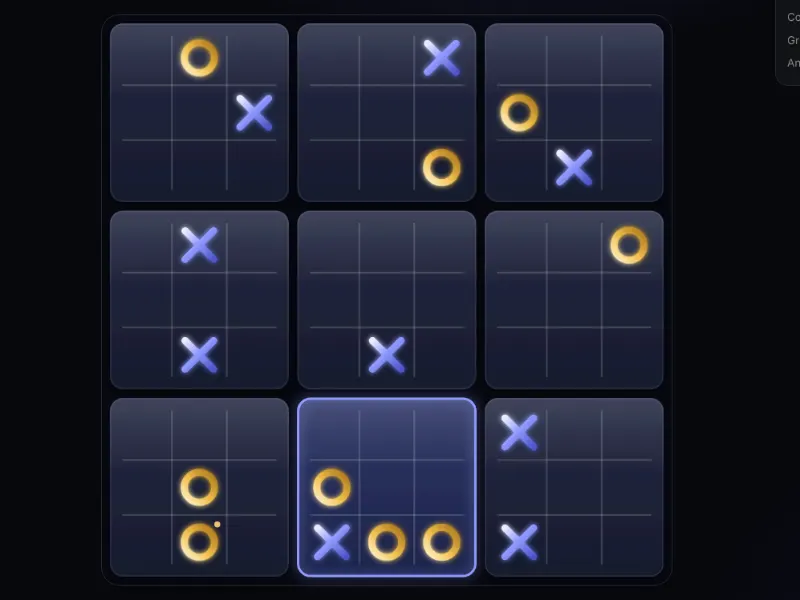
The board is one big tic-tac-toe grid in which every square is itself a small tic-tac-toe. Win a small grid by lining up three symbols in it: it then belongs to you on the big grid. The first to own three small grids in a row wins the game.
The sending rule
- The position of your move within its small grid points to the grid where your opponent must play next. For example, playing in the top right square of a small grid sends your opponent to the top right grid.
- If the grid you are sent to has already been won or is full, your opponent may play in any grid that is still open.
- A small grid that fills up with no line is drawn and belongs to nobody.
- If all the grids are finished with no line on the big grid, the game is a draw.
About the AI
The AI uses a Monte Carlo tree search (UCT): it simulates thousands of game endings to estimate the value of each move. The engine represents each small grid as a 9-bit mask and relies on precomputed tables, which lets it run more than 100,000 simulations per second. It also proves forced wins and losses near the end of the game (MCTS-Solver).
The Master level has several hundred thousand simulations per move; the lower levels use far fewer and sometimes make mistakes.
AI levels
- BeginnerA few hundred simulations: plays fast and by intuition.
- AmateurSees immediate wins, but not much depth.
- IntermediateA solid opponent that exploits the sending rule.
- ExpertTens of thousands of simulations per move.
- MasterSeveral hundred thousand simulations and proven wins: formidable.


