
Texas Hold’em
No-limit poker: read your opponents, size your bets, dare to go all-in.
A no-limit Texas Hold’em tournament against 1 to 5 opponents with distinct styles, rising blinds, all-ins and side pots.
- Players
- 2 to 6 players
- Length
- 20 min
- Against the AI
- Online with friends
15 days of full access, no account · No download
How to play
Goal
Win all the chips at the table. Each player starts with 2,000 chips; the blinds increase regularly until only one player is left. The game ends for you when you have no chips left.
How a hand works
- The dealer button (D) moves one seat each hand. The two players to its left post the small and big blind.
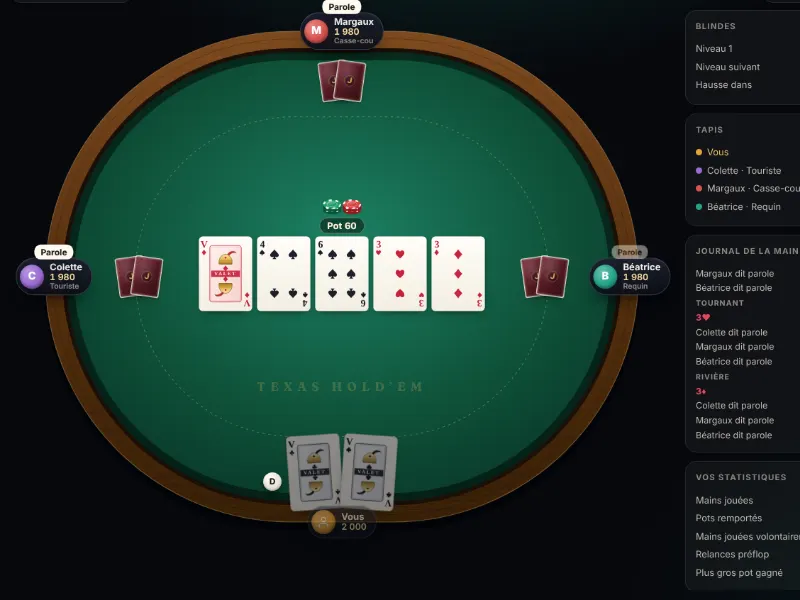
- Each player receives two hidden cards. Four betting rounds follow: preflop, flop (three community cards), turn (fourth card) and river (fifth card).
- On your turn: fold, check (pass without betting), call the bet, bet or raise. With no limit, you can bet all your chips: that is going all-in.
- A raise must be at least equal to the bet or to the previous raise. An all-in smaller than a full raise does not reopen the betting for players who have already acted.
- At the showdown, the best five-card hand, made from your two cards and the five community cards, wins the pot.
All-ins and side pots
A player who is all-in can only win what they were able to cover: each opponent pays them at most their own bet into the main pot. The excess forms a side pot contested among the players who fed it. A bet that nobody calls is returned.
Hand rankings
- Royal flush: ace, king, queen, jack and ten of the same suit.
- Straight flush: five consecutive cards of the same suit.
- Four of a kind: four cards of the same rank.
- Full house: three of a kind and a pair (“kings full of sevens”).
- Flush: five cards of the same suit (“ace-high flush”).
- Straight: five consecutive cards (the ace can be low: ace to five).
- Three of a kind: three cards of the same rank.
- Two pair.
- Pair.
- High card.
Within the same category, the remaining cards (the kicker) break ties; if they are perfectly equal, the pot is split.
Controls
- Bet slider and shortcuts for ½ pot, pot and all-in.
- Keyboard: F fold, C check or call, R bet or raise, Enter next hand.
- The light bulb gives your estimated equity against your opponents’ ranges and a recommendation.
About the AI
Each opponent has a profile (tight or loose, cautious or aggressive). At every decision, a worker estimates each opponent’s range of hands from their public actions (opening raise by position, call, raise, check) and, from Expert level on, from their observed statistics (frequency of play, aggression, folds when facing bets). Equity is then calculated by Monte Carlo simulation (up to 7,000 deals) and compared with the pot odds. Value bets, semi-bluffs, continuation bets and bluffs are measured according to the profile; when short of chips, the AI applies a “push or fold” strategy inspired by the Nash equilibrium. The Beginner level calls far too much, and the Master level adds no noise to its calculations. The AI never receives another player’s hidden cards.
AI levels
- BeginnerOpponents who call almost everything: ideal for learning the value of hands.
- AmateurLoose, passive play: they call too often and rarely bluff.
- IntermediateSolid play: equity calculated against your ranges, consistent bets, a few bluffs.
- ExpertRanges adjusted to your habits, pot odds, position and measured bluffs.
- MasterIntensive Monte Carlo, reads your tendencies, optimized “push or fold” play: formidable.


