
Cairn
Build a tower of stones, hand the worst one to your rival.
Two builders, one tower. Each turn your opponent picks, from several stones, the one you must place, then you pick theirs. Aim, turn, drop: whoever knocks a stone off the platform loses the round. Realistic physics and suspense on every placement.
- Players
- 1 or 2 players
- Length
- 5 to 10 min
- Against the AI
- Two players on one device
- Solo
- Online with a friend
15 days of full access, no account · No download
How to play
Goal
Two builders raise one shared tower of stones on a small platform. Each turn, a stone is placed, but the player who places it is not the one who picks it: the opponent picks it. If a stone falls off the platform, the player who had just placed loses the round. The first to win the majority of the rounds wins the game.
How it works
- The pick: you are offered 3 or 4 stones of different shapes. Touch the one your opponent will have to place, then confirm with “Give this stone”. The dots under each stone show its difficulty: one dot, it is stable; three dots, it is treacherous.
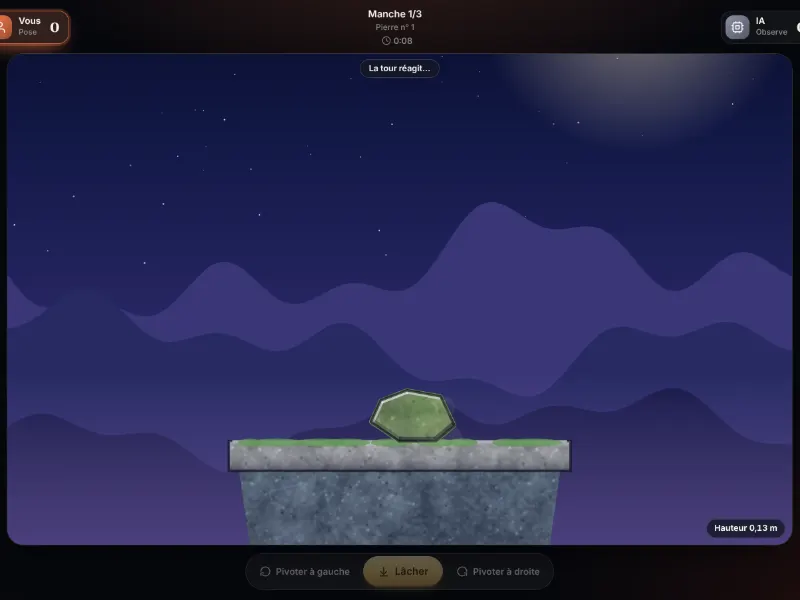
- The placement: drag your finger (or the mouse) left and right to move the stone above the tower; a dotted silhouette shows where it will land. Tap without moving to show it another face. For finer turning, use the rotation buttons, the mouse wheel or two fingers. Release to drop it. To cancel the placement, drag to the very top of the screen before releasing.
- The check: the stone falls, the tower shifts, then everything settles. Once nothing has moved for one second, we check whether a stone has fallen off the platform.
- If no stone has fallen, the roles swap: now you pick your opponent’s stone.
The stones
- Slab: flat and wide, it steadies the tower.
- Block: stocky, it stands well.
- Pebble: rounded, it rolls as soon as it is set down crooked.
- Wedge: cut at an angle, it slides along its sloping face.
- Needle: long and thin, it falls at the slightest misstep.
Controls
- Mouse or finger: drag to move, tap to change face, release to drop.
- Keyboard: left and right arrows (or A and D) to move, up arrow to change face, Q and E to turn, Space or Enter to drop. To pick a stone: keys 1 to 4, then Enter.
Modes
- Vs AI: five levels. The AI simulates its placements and picks for you the stone that will give you the most trouble. The Hint and Undo buttons are there to help you learn.
- Two players: on the same device. The player who picks chooses the stone, the other one places it.
- Solo: a height challenge. A queue of stones is imposed on you, with the occasional big golden slab, wide and easy. The game ends at the first fallen stone: beat your height record.
- Online: a game for two, each on their own device. The physics is identical on both sides, and the result of every placement is verified.
Levels
- Beginner: the AI places stones almost at random and often hands you easy ones.
- Amateur: it looks for a solid base but still lacks precision.
- Intermediate: it checks how stable its placements are and gives you the trickiest stones.
- Expert: it simulates its placements and sets traps for you.
- Master: it works out every placement and every stone to give you.
Platform and rounds
The platform can be wide, standard or narrow: the narrower it is, the shorter and tenser the round. You play one, three or five rounds; the player who places first changes every round.
About the physics
The tower follows a physics engine with a fixed step of 1/60 of a second: rigid bodies, convex polygons, friction, and sleeping for stones that are not moving. It is deterministic, which makes online play possible without any gap between the two screens.
AI levels
- BeginnerPlaces stones almost at random and often hands you easy ones.
- AmateurLooks for a solid base but still lacks precision.
- IntermediateChecks how stable its placements are and gives you the trickiest stones.
- ExpertSimulates its placements and sets traps for you.
- MasterWorks out every placement and every stone to give you.


