
Blockburst
Place glass blocks, burst rows and columns.
Drag three pieces at a time onto an 8 × 8 grid to complete rows and columns that burst in showers of gems. Chain the bursts to multiply your points: alone, against an AI that plays the same sequence of pieces, two players on the same device, or in an online race.
- Players
- 1 or 2 players
- Length
- 5 to 20 min
- Against the AI
- Two players on one device
- Solo
- Online with a friend
15 days of full access, no account · No download
How to play
Goal
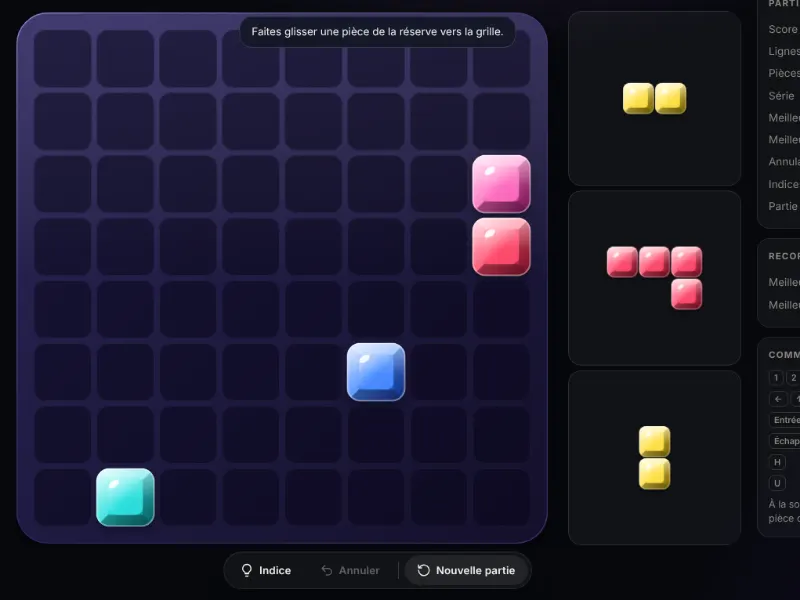
Place pieces made of blocks on an 8 × 8 grid to fill whole rows or columns: every complete row or column bursts and frees up room. Three pieces are offered at a time; once you have placed all of them, three new ones arrive. The game ends when none of the remaining pieces can be placed any more.
How it works
- Drag a piece from the tray onto the grid, with the mouse or your finger. A ghost shows where it will land and the piece snaps to the nearest valid square. Pieces never rotate.
- On the keyboard: keys 1, 2 and 3 (or Tab) pick a piece, the arrow keys move it, Enter or Space places it, Esc clears the selection.
- Every block placed scores 1 point. A burst of 1 row or column is worth 10 points, 2 are worth 30, 3 are worth 60, 4 are worth 100, and so on (rows and columns add up), all multiplied by your streak.
- Streak: every piece that bursts at least one row or column extends the streak and raises the multiplier, up to × 8. The streak survives two pieces without a burst; on the third piece without a burst, it falls back to zero.
- Clean sweep: emptying the whole grid is worth 400 extra points.
Levels
- Easy: empty grid, small pieces only (no zigzags, T shapes or big shapes).
- Medium: 4 blocks to start, every shape, big pieces are rare.
- Hard: 8 blocks to start, the full range.
- Expert: 10 blocks to start, few small pieces, big shapes are common.
- Devilish: 12 blocks to start, hardly any helpful pieces, 3 × 3 squares and crosses galore.
Pieces are drawn from a shared seed: the sequence depends only on the series number and never on your moves. Early in the game, big pieces are rare and every series includes a small piece, so a game is never lost from the start.
Game modes
- Solo: endless score and records for each level. The Hint button shows the best placement, Undo takes back the last placement. Records are only registered without hints or undos.
- Against the AI: the AI plays exactly the same sequence of pieces in parallel on its own grid. The first one stuck sets a score to beat: the winner is whoever survives the longest or scores the most.
- Two players: on the same device, each player takes a turn at a full game with the same sequence of pieces and the same starting grid; scores are compared at the end.
- Online: a simultaneous race against an opponent, with the same sequence of pieces for both; you see their grid and score live. The best score wins.
About the AI
The AI is a greedy player with lookahead: for each series, it tries every order in which the remaining pieces can be placed and all of their placements (a beam search), then scores every resulting grid: points earned from bursts and the streak, isolated squares and holes, roughness of the edges, filled squares and, at the higher levels, how many spots remain for the big pieces. It plays the first move of the best sequence. Lower levels try fewer orders, look at fewer placements and add some randomness to their evaluation. The computation runs in a separate thread.
Difficulty levels
- EasyEmpty grid and small pieces without zigzags: place, burst, learn.
- MediumFour blocks to start, T and zigzag shapes, a few big pieces.
- HardEight blocks to start and the full range of pieces, big ones included.
- ExpertTen blocks to start, few small pieces, big shapes are common.
- DiabolicalTwelve blocks to start, hardly any helpful pieces, 3 × 3 squares and crosses galore.


